

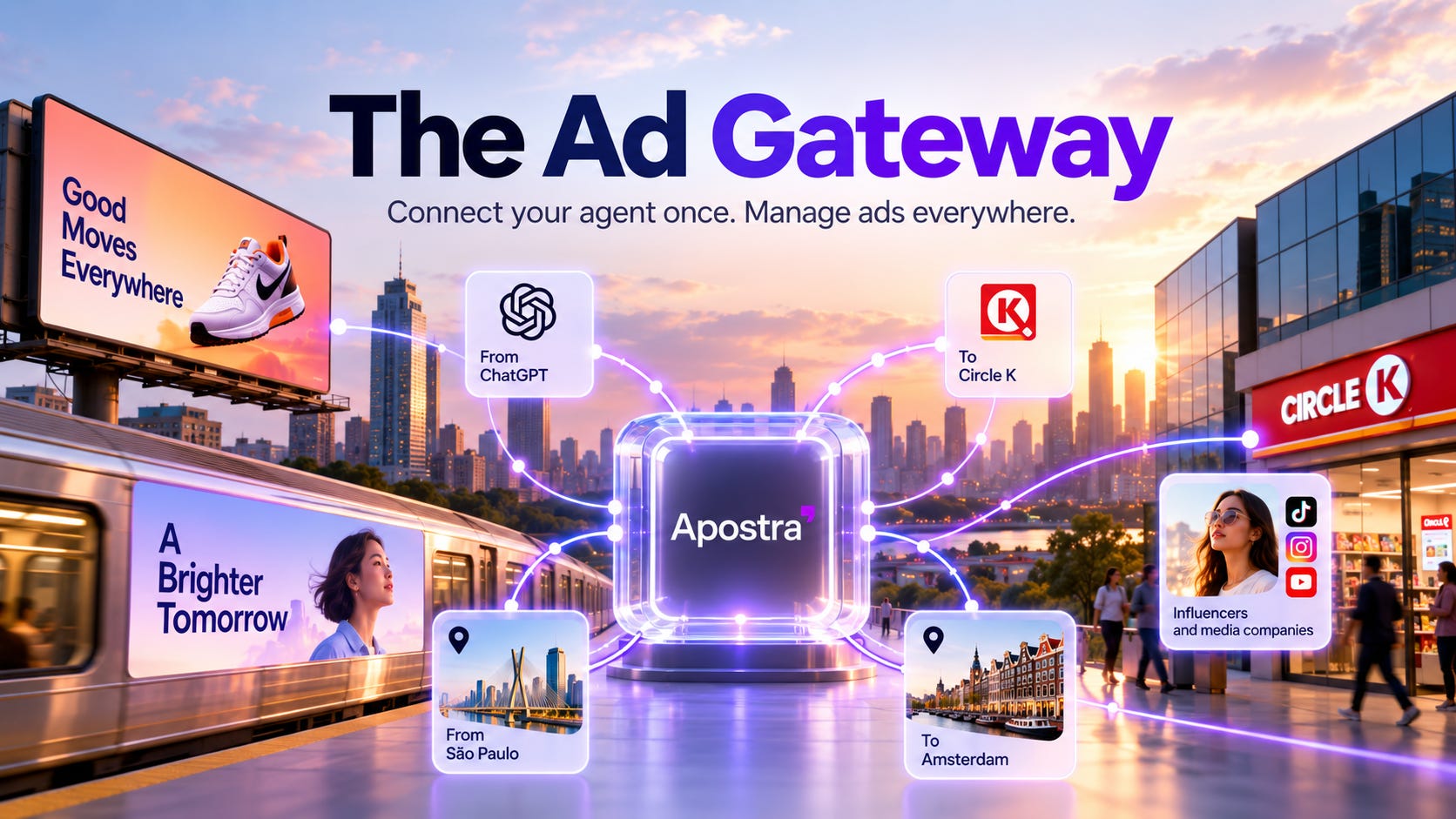
Connect your agent once and manage ads across thousands of advertising surfaces. From ChatGPT to Circle K, from São Paulo to Amsterdam. Online and offline, digital and physical, influencers and traditional media companies. You might think that sounds ambitious. It is. And it’s also a reality - not on every ad surface yet, but more than you think.
What we are talking about is agents taking action in the real world. Agents that can get vinyl up on a billboard or paper into a subway car, not to mention pictures on screens.
This requires a mechanism for information and intent to move from agent to advertising surface. I have been pondering this concept for years, playing with different iterations - anybody want to buy federatedbidder.com from me? - but I couldn’t figure it out.
Advertising isn’t a decisioning problem, it’s a coordination problem. Not who wins the impression, how do we - the brand and the creator - collaborate to make the biggest impression. This means that the biggest opportunities in advertising today are threefold:
Connection: how do we connect as many agents together as possible with as little friction as possible
Orchestration: how do we help these agents collaborate with humans to amplify creativity and help brands change hearts and minds
Governance: how do we make sure agents don’t screw everything up
To solve the connection problem, we need an “agentic advertising gateway”, or ad gateway for short.
It’s similar to the AI model gateways like OpenRouter that let agents connect once and get access to hundreds of models. Instead of going through the laborious signup process for each one, deal with all the credit cards and API keys, developers could try new models with no friction or overhead. These model gateways added other services on top like observability (seeing what requests and responses were going back and forth), cost management, governance, load balancing, and much more. They were a technical solution to a business problem - and given that Stripe is buying OpenRouter for a rumored $7B, a valuable one.
How an ad gateway works
If you aren’t familiar with the Ad Context Protocol, or AdCP, here’s a quick walkthrough:
The advertiser registers an account with a media partner and sets up audiences and measurement (
sync_accounts, sync_audiences, sync_event_sources)The media partner shares their catalog of available inventory and signals (
list_products, get_signals)The advertiser may send a brief and ask for a proposal, or just make a buy from the catalog (
request_proposal, accept_proposal, buy_products)Creatives are sent and reporting data flows (
sync_creatives, get_media_buy_delivery)The advertiser pays the media partner directly
An ad gateway does exactly the same thing but connects to multiple media partners at once. All of the AdCP constructs are the same (though implementors may add their own extensions):
The advertiser registers an account with the ad gateway (
sync_accounts, sync_audiences, sync_event_sources); the ad gateway sets up accounts with relevant media partners (sync_accounts, sync_audiences, sync_event_sources for each partner)All of the connected media partners share their catalogs of available inventory and signals (
list_products, get_signals once)The advertiser may send a brief and ask for a proposal (which is then sent to all the connected media partners), or just make a buy from the catalog (
request_proposal once, accept_proposal / buy_products for each partner)Creatives are sent, reporting data flows (
sync_creatives, get_media_buy_delivery once)The advertiser pays the media partners directly (possibly with invoices consolidated by the ad gateway)
A few key things to highlight here.
Ad gateways help buyers and sellers to manage scale and reduce tokens. The gateway can filter, cache, and combine to make requests and responses smaller and more relevant.
Ad gateways simplify contracts, authentication and authorization. Ad gateways will offer (optional) standardized agreements to remove the legal overhead of adding new sellers. Ad gateways will manage credentials across connected agents and manage mappings between accounts, advertisers, and users.
Ad gateways consolidate observability and governance. If every transaction goes through the ad gateway you have a single point to confirm that every single action is correct, appropriate, and authorized. The ad gateway can flag and hold transactions for human approval directly or in combination with a governance agent.
The ad gateway does not participate in the media transaction. Ad gateways are transparent, like glass: both sides can see right through. Advertisers can pay publishers directly or the gateway can consolidate payments, but either way every penny is accounted for.
AdCP is an open protocol, so can’t buyers just do these integrations with media platforms themselves? Sure. And many of them will. Even with AI, though, this is still an expensive, arduous, and annoying process - and it’s not just technical. You need to go through legal processes, work out integration details, and generally spend weeks or months on each one. Ad gateways save time, money, and tokens so buyers and sellers can do their real jobs building audiences through creativity.
There will be many ad gateways. Some will be embedded in buying platforms. Some will be standalone companies. The more ad gateways, the more agents can connect with minimal friction - and the more value gets unlocked for brands, creators, and consumers.
The four laws of Ad Gateways
In tribute to Asimov, a proposal for the rules of the road for ad gateways:
Ad gateways must ensure participants comply with platform, industry, and regulatory policies - and may be opinionated about who can participate. Zero tolerance for bad actors.
Ad gateways don’t participate, financially or otherwise, in media transactions. They monetize through access fees and add-on capabilities. Zero take rates.
Ad gateways don’t bundle media (with data, creative, etc). Zero principal media.
Ad gateways can bridge formats, currencies, definitions, and protocols - but only if transparent, at cost, and opted into by both sides. Zero arbitrage.
Ad gateways vs ad exchanges
The ad exchange was about scale (more impressions). The ad gateway is about scope (more surfaces).
The ad exchange commoditized demand and supply. Ad gateways let buyers and sellers express unlimited complexity and information.
The ad exchange required an algorithm because humans can’t make a decision in 100ms. The ad gateway requires an agent because humans can’t be experts on every media surface and every media moment.
The ad exchange helped ad tech firms monetize complexity. Ad gateways help marketers and creators monetize creativity.
Ad gateways raise the floor. Ad exchanges lowered the ceiling.
Agentic humans make empowered decisions in conversation with data. Programmatic algorithms pull levers to manipulate data.
Agentic systems and organizations improve over time, perhaps exponentially. An ecosystem built for agentic systems and organizations will too.
Apostra: The ad gateway
You may have noticed that BOKonAds now has a co-host: Anne Coghlan. The two of us have been ideating and inventing together for a decade, since the development of AppNexus Programmable Bidder, and I (Brian) realized that since we were co-creating these posts we might as well just co-author the whole thing. And in truth, it’s time. The next generation of advertising doesn’t need a godfather. It needs a village that can mentor and nourish the people and agents that will define how brands, creators, and consumers co-invent our future together.
Yesterday, we - along with our co-founder Emma Mulitz and our amazing team - announced the launch of Apostra. Check out Anne’s article here!
Apostra is the world’s first ad gateway. We launched with forty media partners representing hundreds of billions of dollars of media from in-store audio to local linear TV to influencers to the largest ad platforms in the world. Our goal is to have every single advertising surface, every media company, and every creator available through the gateway… and we’re well on our way.
It costs nothing to connect your agent to Apostra. You can buy and sell ads today, for free. If you like, you can pay to add additional capabilities, from pre-built agents that assemble kick-ass agentic proposals to AI Business Rules that help you ensure that you only run campaigns and creatives you’re comfortable with.
And because Apostra is built on the Ad Context Protocol, every transaction is executed with Embedded Human Judgement, a native governance protocol and philosophy that ensures that agents act in the best interests of their humans.
How to connect your agent to Apostra
Have your human set up an Apostra account. Accept the terms of service and route you through a few setup tasks. If you haven’t published a brand.json file on your corporate domain (or on the AAO community registry) it will walk you through those steps.
Then, connect your AI platform:
ChatGPT - install the ChatGPT plugin
Claude (Chat or Cowork) - add a custom connector at
https://api.apostra.com/mcp/v3Codex (Run in a terminal):
codex plugin marketplace add https://github.com/apostra-public/apostra
codex plugin add apostra-developer@apostra
Claude Code (Run in Claude Code):
/plugin marketplace add https://github.com/apostra-public/apostra
/plugin install apostra-developer@apostra
You can also use the built-in chat at app.apostra.com
Connecting to media partners on Apostra
By default, you’ll be connected to premium media partners around the world. Some media partners, including Meta, Google, ChatGPT, Pinterest, Reddit, LinkedIn, Spotify, Amazon, and TikTok, will ask you to connect your existing accounts. (Yes, that’s right: we provide AdCP adapters for all the major platforms!)
You can change the connections you want to make per account or per advertiser. As with everything Apostra, you can have your agent do it for you (using our MCP interface) or do it yourself (via chat or MCP-UI widgets like the ones you see above).
Managing campaigns on Apostra
Apostra speaks AdCP in both directions. This means that any AdCP-compliant agent can connect to Apostra to manage the full media buying lifecycle.
Since AdCP is inherently an agent-to-agent protocol, we have added an optional campaign object that can manage media buys across multiple sales agents, allocating budgets and distributing creatives automatically.
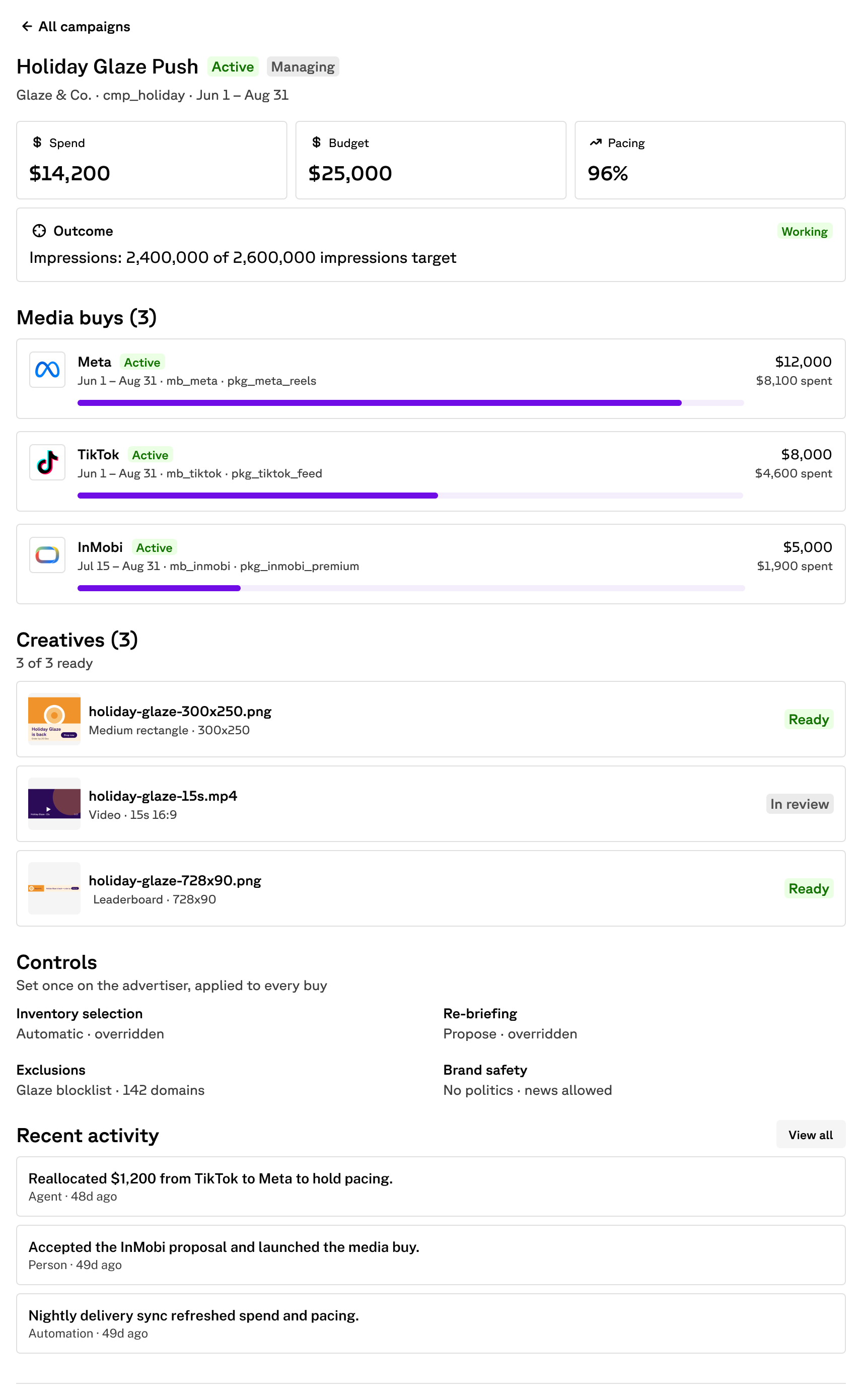
We have also added tools to help with the multi-seller, multi-format creative workflows that AdCP makes possible.
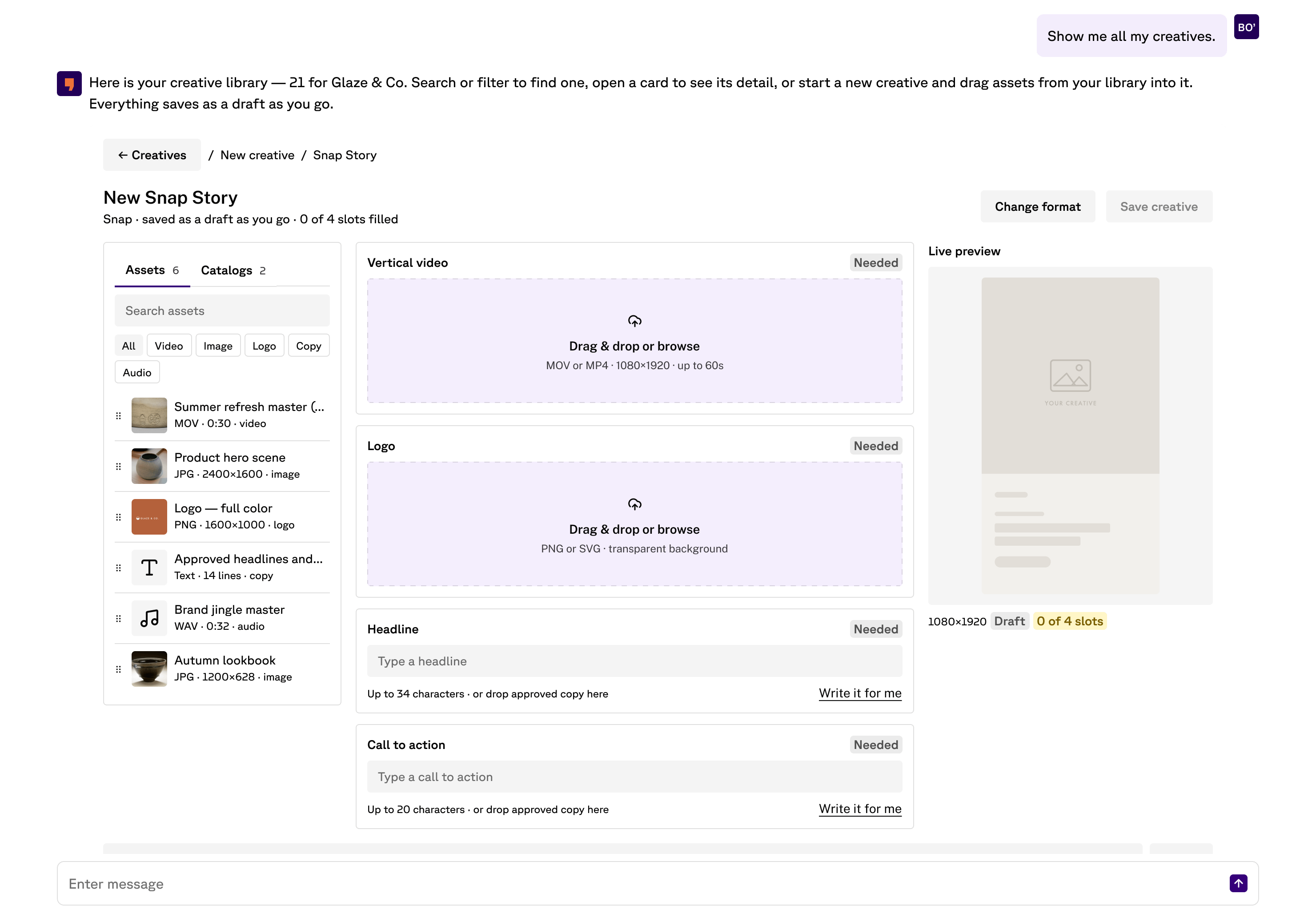
Behind the scenes, we’re managing distributed synchronization with all of the sellers and agents involved in each of these transactions. More on the tech in a future post!
Building Apostra into agentic workflows
Where things start to get interesting is when you start connecting Apostra into your data and event pipelines.
Apostra implements the AdCP 3.2 Reliable Reporting protocol. This means that whenever there is new data from one of your buys, it gets sent to a destination of your choice. We currently support cloud storage buckets (S3, GCS, Azure) and cloud data platform (Snowflake, Databricks). We support both snapshot and daily updates.
Apostra also implements the AdCP 3.2 clean room protocol, enabling cross-agent orchestration of audience workflows. You put your data in one or more clean rooms; Apostra will make sure all your supply partners are configured as destinations (and removed when the data is no longer needed).
Apostra integrates with your measurement providers and event sources, effectively creating a universal Conversion API.
Putting all of this together gives us a holistic event loop: Apostra fires events when interesting things happen. Your agent gets source of truth data and the tools to take action.
Apostra drives the holistic event loop that powers agentic advertising.
Why not just integrate directly with the ad platforms?
Integrations still require understanding all the underlying complexity of the platform. Every integration will be bespoke; every API change will require updates. None of these platforms does a great job with data delivery or events, even from their standard APIs. They were built for the programmatic era, not the autonomous era.
The premise of Apostra is that you can integrate once and advertise everywhere. Every media company that lists on Apostra competes for your marginal dollar. Will publisher X outperform Meta on your entire campaign? Probably not. But will their best $100 outperform Meta’s worst $100? It’s worth a shot, especially if an agent can manage that process without any additional hassle.
Won’t there be lots of ad gateways?
Maybe. It has been a LOT of work to build Apostra, and while AI is clearly making it easier to build integrations, it’s not making it much easier to build reliable, scalable, safe systems that can manage large financial transactions efficiently.
We are very happy to be “Apostra Inside” and power other companies. We are not going to compete with Amazon as the gateway to their customers, nor their ability to get proprietary access to CTV platforms. But we might be able to help them get direct access to hundreds or thousands of media companies with premium media around the world that they can’t buy through RTB. I think that model is valuable all around, whether to agencies or CRM companies or data clouds or consultancies.
Our commitment to not participate in media means that we aren’t competing with our partners. We have no incentive to get an advertiser to spend more. Our job is to connect brands and creators - and their agents - as effectively as possible. And we plan to do that job better than anyone else in the world.
This is a new paradigm. Exactly what I'd expect from BOK, Anne, and the team there at Apostra. I'm going to watch this area closely as I work with publishers who could possibly participate in this ecosystem.
This is a fascinating shift in how we think about advertising infrastructure. The move from simply connecting platforms to letting agents coordinate and act across them changes the role of governance quite a bit.
One piece I’d add is signal quality. If agents are making decisions and optimizing campaigns autonomously, the data they’re acting on needs to be trustworthy too. Otherwise, automation can simply make the wrong signals move faster.
The future of agentic advertising may depend as much on clean signals as it does on seamless connections.